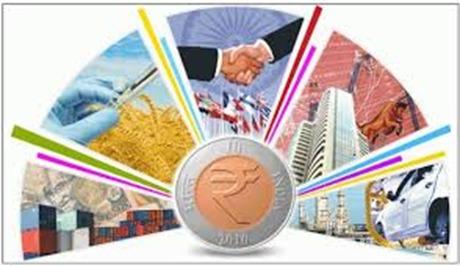
India’s Economic Journey: From Independence to Emerging Superpower
The Indian Economy
The Indian economy refers to the economic system and activities in India, which is one of the largest and fastest-growing economies in the world. It includes the production, distribution, and consumption of goods and services in the country.
Features of the Indian Economy
- Mixed Economy: India is a mixed economy, meaning it combines elements of both capitalism (private sector) and socialism (public sector). Both the government and private players participate in economic activities.
-
Sectors of the Economy:
- Primary Sector: Agriculture, fishing, forestry.
- Secondary Sector: Manufacturing and industry.
- Tertiary Sector: Services like banking, IT, education, and healthcare (this is the largest sector in terms of GDP contribution).
- GDP and Growth: India has a nominal GDP of over $3.7 trillion (as of 2024) and is the fifth-largest economy in the world. It’s also one of the fastest-growing major economies, with a focus on digitalization, services, and manufacturing.
-
Key Industries:
- Agriculture (still a major employer)
- Information Technology (IT) and Software Services
- Textiles
- Pharmaceuticals
- Automobiles
- Telecommunications
-
Challenges:
- Poverty and unemployment
- Income inequality
- Infrastructure gaps
- Inflation
- Bureaucratic hurdles
-
Opportunities:
- Young and growing population
- Digital economy expansion
- Renewable energy investment
- Global manufacturing hub potential
Difference Between India’s Economy in the 1990s and 2020s
-
Economic Model
- 1990s: Closed and controlled economy with lots of government regulations (License Raj).
- 2020s: Liberalized and market-driven economy, open to private and foreign investments.
-
Growth and GDP
- 1990s: Slow GDP growth (3-5%), recovering from a balance of payments crisis.
- 2020s: Fast-growing economy with GDP growth often above 6%.
-
Global Integration
- 1990s: Limited foreign trade and investment.
- 2020s: Highly integrated globally with strong exports and multinational operations.
-
Technology & Innovation
- 1990s: Minimal tech adoption, no internet or mobile revolution yet.
- 2020s: Leading in digital economy with smartphones, UPI, and startups.
-
Key Industries
- 1990s: Focused on agriculture and basic industries.
- 2020s: Dominated by IT, fintech, e-commerce, and manufacturing (“Make in India”).
-
Poverty & Middle Class
- 1990s: Higher poverty, small middle class.
- 2020s: Reduced poverty and a large growing middle class driving consumption.
-
Government Reforms
- 1990s: 1991 economic liberalization (led by Manmohan Singh).
- 2020s: Reforms like GST, demonetization, Make in India, Startup India, PLI schemes.
Theme of the Indian Economy
The central theme of the Indian economy is its transformation from a traditional, agriculture-based economy to a modern, diverse, and rapidly growing economy. It reflects the journey of:
- Economic liberalization (starting in 1991)
- Technological progress (rise of digital and IT sectors)
- Balancing growth with social development
- Striving for inclusive and sustainable development
It’s a story of how a mixed economy tries to balance public welfare with private enterprise, tradition with innovation, and rural development with urban progress.
Conclusion of the Indian Economy
India’s economy is:
- Resilient and diverse – despite global challenges like pandemics, wars, or inflation.
- Full of potential – due to its young population, large domestic market, and tech-driven innovation.
- Still faces challenges – like unemployment, income inequality, infrastructure gaps, and need for stronger education and health systems.
But it is on a path to becoming a global economic powerhouse, possibly reaching the Top 3 economies by 2030 if reforms and investments continue.